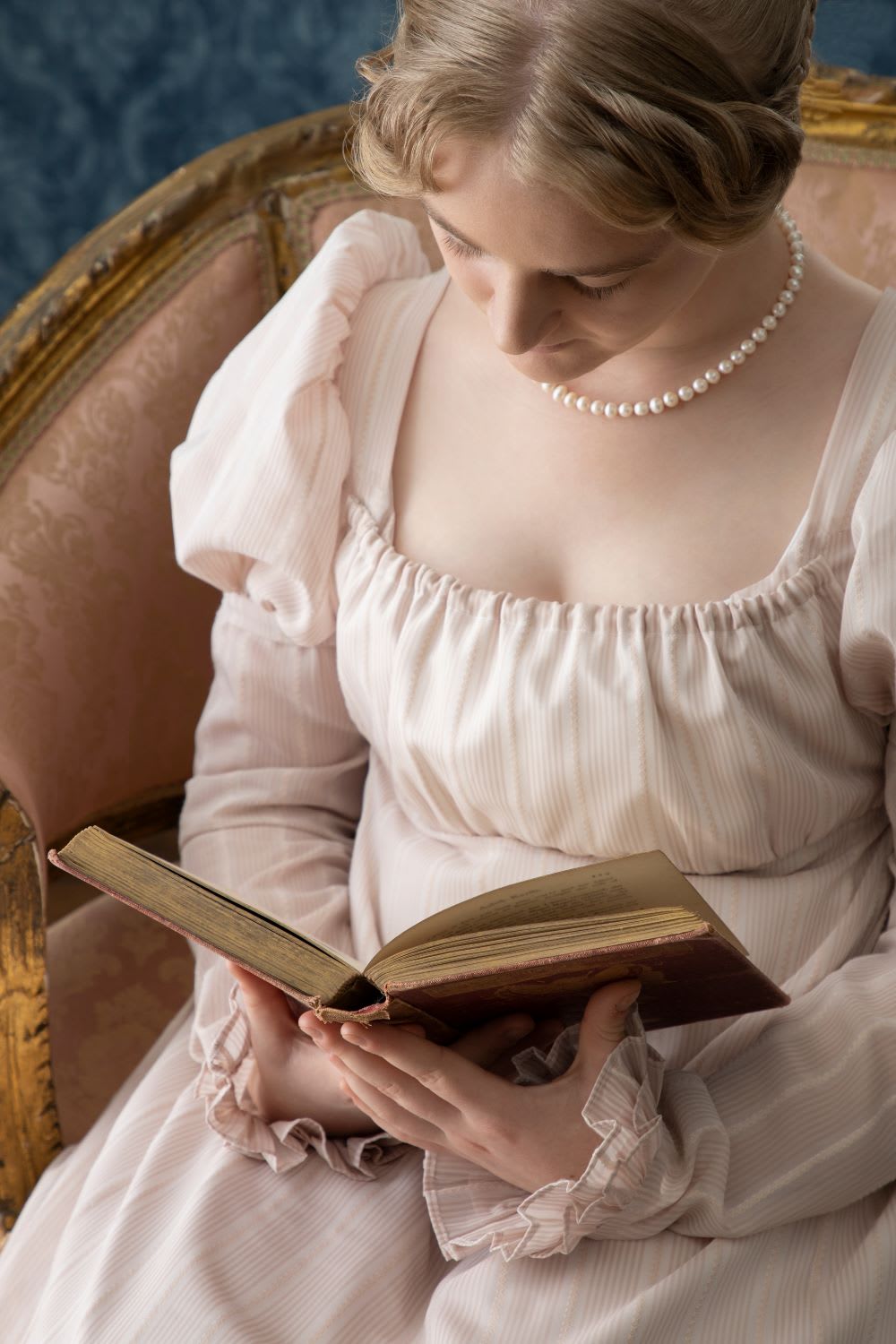
Elegance in fashion and great achievements in fine arts and architecture are trademarks of the Regency Era. The Regency Era formally began in 1811 and ended in 1820, lasting just nine years. Although works as early as 1795 and as late as 1837 have been labeled as Regency, the reign of the prince regent is what defines it. King George III was officially declared unfit to rule in 1811 due to a long struggle with mental illness. His son George, Prince of Wales, was assigned to rule in his stead. With a prince regent in place, the Regency Era began. In 1820, the prince regent ascended to the throne upon the death of his father, which formally marked the end of the Regency Era.
Regency Fashion
The high-waisted, undergarment-inspired chemise dress was in fashion for women during the Regency Era. Marie Antoinette, the last queen of France, is credited with the popularity of the chemise dress. However, during the Regency Era, it was considerably more modest than it had been in previous years. Most of England’s supply of silk had been destroyed in battle, so the dress was commonly constructed of cotton.
With the migration of former country-dwellers to the cities during the Industrial Revolution, fashionable clothing had an equestrian flair. This could be seen in ladies’ knee-length riding jackets that were open in the front to reveal the dress underneath. Fashion plates of the time often show women carrying riding crops.
Men’s fashion consisted of a shirt, generally made from muslin, that slipped on over the head. These were topped by a waistcoat and a jacket very similar to a modern tuxedo jacket with tails. As for trousers, men were offered a wide variety of choices, including breeches, trousers, pantaloons, buckskins, and “inexpressables.” Knee-length breeches were worn with stockings. Trousers with suspenders became en vogue for the upper class around 1807. Pantaloons were very fitted and worn with tall boots. Buckskins, made from deerskin, were common, rugged, and comfortable. “Inexpressibles,” on other hand, were scandalously tight leggings that left little to the imagination.
Culture and Lifestyle
In his younger years, the prince regent was referred to as “the First Gentleman of Europe.” His influence could be seen not only in the clothing of the day but in the values and culture of the time. As a great patron of art and architecture, he owned many fine paintings and commissioned great architecture.
England was at war for much of the Regency Era fighting both to gain new lands and defend the ones it had already conquered. Napoleon was on the march, and England was one of his many targets. Fears of invasion by France weren’t calmed until English forces under Arthur Wellesley, later named Duke of Wellington, defeated the French at the Battle of Talavera in Spain in 1809. In 1815, Britain soundly defeated the French at Waterloo, putting fears of invasion to rest and confirming England as the dominant European power.
Regency fashion, architecture, and art reveal a convergence of several influences of the time. Hints of Revivalism, Orientalism, and Romanticism were apparent in art and architecture as well as clothing. A strong Egyptian influence can be seen during this era that was likely a result of the Royal Navy’s defeat of Napoleon in the Battle of the Nile in 1798.
Until this time, the French had dominated not only fashion but art and architecture. The Regency Era saw England laying claim to its own style. Social upheaval was prevalent during this time and of great concern for the ruling elite. War had increased the demands of the Industrial Revolution, but once it was over, political and social unrest became the fashion of the day. Brits were becoming more aware of and vocal about the great chasm between the ruling class and the poor working class.
Fine Arts and Architecture
One of the most important architects of the time was John Nash. Nash made significant contributions to domestic architecture even prior to gaining the patronage of the prince regent. He designed the Brighton Pavilion, Regent Street, Regent’s Park, and Buckingham Palace as well as a series of picturesque villas, cottages, and country houses throughout England.
For many, Jane Austen’s novels define the Regency Era; however, she is not the only wordsmith of the time. Other acclaimed authors and poets from this time period include Mary Shelley, William Wordsworth, John Keats, William Blake, Sir Walter Scott, Maria Edgeworth, Susan Ferrier, and Percy Bysshe Shelley.
- History of George IV
- Georgian History
- Hierarchy and Seduction in Regency Fashion
- Examples of 1807 Dresses
- Regency Men’s Style
- How Drop-Front Gowns Fastened
- Regency Style Influenced by Egypt
- The Regency Era Defined
- George IV: The Rehabilitation of Old Naughty
- Regency Art and Architecture
- Empire vs. Regency Style Dresses and Shoes
- Places to See Georgian Architecture
- Social Classes, Money, and Servants: Culture Reflected in the Works of Austen
- How to Dress Like a Jane Austen Character
- The Romantic Movement and the Regency
- Historical Context of Pride and Prejudice
- Entertainment in the Regency Era
- Mary Shelley
- About Regency Fashion
- The Georgian Kings
- George IV: The Most Hopeless Prince?
- The Coronation of George IV
Want to try the Regency-inspired look? Shop our Regencycore Trend selection!