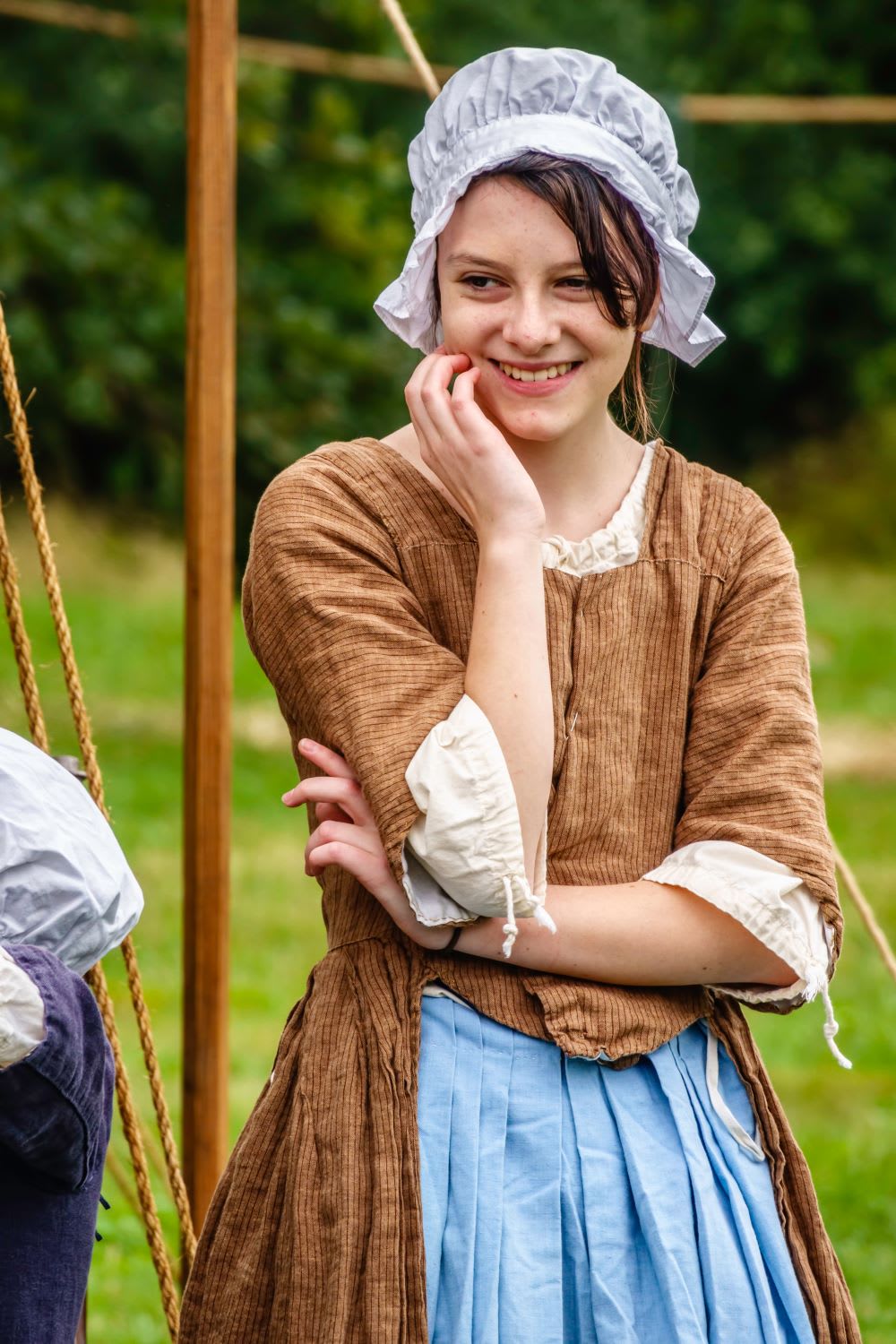
The original colonists were mostly Puritans. Their belief system was firmly rooted in simplicity and modesty, and their clothing reflected this. Coming primarily from England, where clothing was a source of pride and class distinction, the Puritans wanted to dress simply and plainly. There were no frilly collars, elaborate buttons, or adorned handkerchiefs. Colonial clothing did not use silks, satins, or velvets but instead practical material that would hold up well.
Men’s Colonial Clothing
Colonial men wore clothes of wool and linen with some leather accessories. Their long linen shirts were worn with breeches, short pants that fasten just below the knee. Woolen socks came up over the knees, and a leather jerkin, a type of vest, was often worn over the shirt. A doublet is a padded jacket with sleeves, and you would sometimes see these worn as well as belts. Shoes were simple for colonial men, typically made of leather and free of buckles. The men often wore wide-brimmed hats and a cape or coat if needed.
Women’s Colonial Clothing
Colonial women’s clothing was anything but extravagant. It was heavy and made of primarily wool and linen. The first layer was a shift, which is a long and loose nightgown-type undergarment. Over the shift, women wore a petticoat, which gave their skirt or dress fullness when they layered it on next, possibly with a belt. Similar to the men, women wore long woolen socks and plain leather shoes. All clothes were held on by laces, and typically, an apron covered up a big part of the dress. Women wore their hair long, pulled up, and covered by a cap called a coif. It fit closely against the head to prevent their hair from being a source of pride or boastfulness.
Children’s Colonial Clothing
Boys and girls were not dressed much differently, if at all, as infants and young children, but they became accustomed at a young age to the traditional Puritan clothing of the adults. Children younger than seven wore simple shifts, and around seven or eight years old, they would begin wearing clothing similar to that of the adults.
Servants’ Colonial Clothing
Following an old English tradition, colonial servants wore blue. Woad, a dye used to color clothing blue, was cheap and therefore had traditionally represented servitude. In colonial America, servants continued to wear blue and were thus set apart from the other colonists.
Sumptuary Laws
There was a long history of sumptuary laws in England. These laws dictated what people could wear according to their class and position in society. These laws were repealed in 1603, much to the dismay of many Puritans. In 1651, the leaders within the Puritan colonies put into place their own version of sumptuary laws. These laws dictated what the common colonists could not wear. Only the educated and upper-class members of society were allowed to wear gold or silver lace or buttons, and the wearing of silk hoods or scarves by women was also prohibited except for by wealthy or highly educated colonists.
Colonial Clothing Colors
There were no bright colors in Puritan clothing. They wore clothes in muted red, brown, black, green, and blue tones. White was used to represent purity and was shown in collars, cuffs, and aprons. The colors in clothing were often symbolic. Black was common because not only did it represent plainness, but it was cheaply produced. The blue worn by servants represented heavenly grace, and gray stood for fasting, prayer, and repentance. The red tones symbolized courage, and brown symbolized humility and poverty. Green, because of its presence in nature, represented the renewal of life, while pale yellow brought about feelings of renewal and hope.
Colonial Textiles
Serge was the most common material used for curtains and upholstery and was often used for clothing. Serge is long-lasting twilled wool. Linsey-wooley was made from a combination of linen and wool and was coarse and very strong. Because of its durability, it was a popular choice for clothing. Most households did not have the equipment to spin yarn from wool or weave yarn into textiles, so while they typically made their clothes, they had to purchase the materials to do so.
- Colonial America for Kids: Men’s Clothing: Here, kids can learn all about how men dressed in colonial America.
- Men’s Clothing from 1700 With Pictures: Imagine yourself in colonial America by reading about the clothing of the time.
- How Much Clothing Did an 18th-Century Woman Really Own? It’s difficult to determine how much clothing a typical woman in the 1700s had.
- Clothing of the 1830s: Clothing styles changed greatly between the early settlement of America and the end of the colonial period.
- Fashion History Timeline: 1770-79: Explore this timeline to see how clothing changed over time and what fashions were in style during the American Revolution.
- The Puritan Dress Code and the Outrage of Slashed Sleeves: Why did the Puritans rebel against the fashion of slashed sleeves, and what other laws regarding clothing did they follow?
- Clothing in Colonial Massachusetts: Clothing could vary a lot by region in colonial America.
- The Hidden Rules of the Puritan Fashion Police: What rules existed to control how the Puritans dressed, and how were these rules enforced?
- Clothing and Fashion in the 13 Colonies: Read about what was considered in style in the colonies on this page.
- Dress in Colonial America: Learn more about what the first settlers wore.
- Why Different Cultures, Including the Puritans, Dress a Certain Way: Examine cultural factors that influenced popular clothing styles.
- Puritan Life: Think about what life was like for the Puritans and how this may have affected the way they dressed.
- Sumptuary Laws: The historical record shows many examples of societies regulating how people dressed by their social or economic status.
- The Puritan Experiment With Sumptuary Legislation: Learn what happened when the Puritans enacted sumptuary laws on this page.
- Important Puritans and Their Laws: To fully understand a culture, including the dress, it is essential to know about the people and laws of the time.
- Puritan Economics: What were the beliefs surrounding free trade and supply and demand in the Puritan colonies?
- How Did Puritan Clothing Support Religious Views? When Puritans chose the “appropriate” clothing, much of their decision-making was based on religious belief.
- Puritan Clothing’s Effect on a Religious Movement: Read more about how members of the new religious movement dressed as they migrated from Europe on this page.
- What Did They Wear on the Mayflower? It’s a little easier to imagine crossing the ocean on the Mayflower when you have an idea of what most of the passengers wore.
- Puritan Massachusetts: Theocracy or Democracy? The religion of the Puritans strongly influenced every aspect of their culture.
- Puritan Culture and the Salem Witch Trials: The restrictiveness of Puritan society and belief in the supernatural contributed to witch hunts.
- Ultimate Fashion History: The 17th Century: As settlers were moving to America, what fashions were they leaving behind in Europe?
- The New England Colonies: Multiple groups of people fled England because their beliefs led to their oppression there.
- Gender Roles in Colonial America: How people dressed was in part a reflection of gender roles in colonial America.
- An Examination of Scandalous Puritan Women: In a straitlaced society, not all women were prim and proper. Like in any era, some went against the grain.
- Ten Things You May Not Know About the Puritans: Learn ten interesting facts about the Puritans on this page.
Join The Conversation (2)
hi
Nice source of info! Really helped me with my schoolwork.